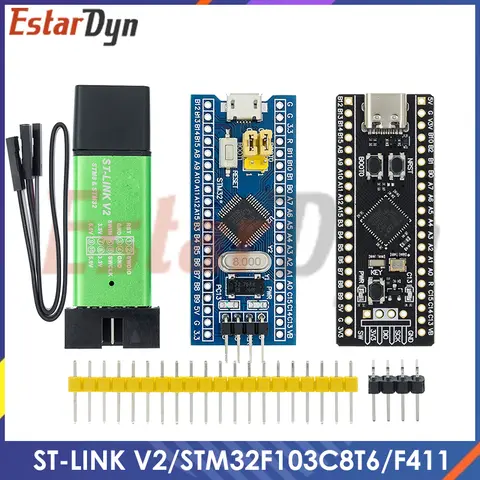
Which STM32 Board is Best for a Beginner in Embedded Systems?
If you're new to embedded systems and looking for a reliable and affordable STM32 board to start your journey, the STM32F103C8T6 Blue Pill is the best choice. This board is widely used in the maker community due to its low cost, ease of use, and strong support from the open-source community.
- STM32 Board
- A microcontroller development board based on the STM32 series from STMicroelectronics, commonly used for embedded applications.
- STM32F103C8T6
- A popular microcontroller in the STM32F103 series, featuring 72 MHz clock speed, 64 KB of RAM, and 512 KB of flash memory.
- Choose the Right Board: The STM32F103C8T6 is ideal for beginners due to its affordability and extensive documentation.
- Set Up Your Development Environment: Use STM32CubeIDE or Arduino IDE with STM32 support to write and upload code.
- Start with Simple Projects: Blink an LED, read a button input, or interface with a sensor to get familiar with the board.
- Join the Community: Engage with online forums and GitHub repositories to find tutorials and sample code.
In my experience, the STM32F103C8T6 is a great entry point for learning embedded programming. It supports a wide range of peripherals and is compatible with various shields and modules, making it a versatile platform for both learning and prototyping.
How to Choose Between STM32F Board and STM32H7 Board for a High-Performance Project?
When deciding between the
STM32F board and the
STM32H7 board, the key factor is the performance requirements of your project. The STM32H7 board is the better option for high-performance applications due to its faster clock speed, more memory, and advanced features.
| Feature | STM32F Board | STM32H7 Board |
| Max Clock Speed | 72 MHz | 480 MHz |
| Flash Memory | Up to 1 MB | Up to 4 MB |
| RAM | Up to 128 KB | Up to 1 MB |
| Peripherals | Basic set of peripherals | Advanced peripherals including USB 3.0, CAN FD, and more |
- Assess Your Project Requirements: Determine if you need high-speed processing, large memory, or advanced peripherals.
- Compare Specifications: Use the table above to compare the key features of STM32F and STM32H7 boards.
- Consider Power Consumption: The STM32H7 board may consume more power, so ensure your power supply can handle it.
- Check Development Tools: Both boards are supported by STM32CubeIDE, but the STM32H7 may require more powerful hardware for development.
In a recent project, I used the STM32H743 board to develop a real-time data acquisition system. The high clock speed and large memory allowed me to process and store data efficiently, which would not have been possible with an STM32F board.
When selecting an
STM32 development board, it's important to consider several key features that will impact the performance and usability of your project. The most important features include clock speed, memory size, peripheral support, and development tools.
- STM32 Development Board
- A board designed for developing and testing applications using STM32 microcontrollers.
- Peripheral Support
- The availability of hardware interfaces such as UART, SPI, I2C, USB, and CAN on the board.
- Clock Speed: Higher clock speed means faster processing. For real-time applications, choose a board with at least 120 MHz.
- Memory Size: Ensure the board has enough flash and RAM to accommodate your application. For complex projects, aim for at least 512 KB of flash and 128 KB of RAM.
- Peripheral Support: Look for boards with a wide range of peripherals to support your project's needs. Boards like the STM32H723 and STM32MP1 offer advanced peripheral sets.
- Development Tools: Choose a board that is supported by popular development tools like STM32CubeIDE, Keil, or Arduino IDE.
In my experience, the
STM32 Nucleo Board is an excellent choice for developers who want a board with built-in debugging and a wide range of peripherals. It also supports a variety of STM32 microcontrollers, making it a flexible option for different projects.
User feedback is an important factor when choosing an STM32 board. Here are some common user reviews and experiences with popular
STM32 boards:
| Board | Pros | Cons |
| STM32F103C8T6 Blue Pill | Low cost, easy to use, large community support | Limited memory and peripherals |
| STM32H743I-Discovery | High performance, advanced peripherals, good for complex projects | Higher cost, more complex setup |
| STM32 Nucleo Board | Integrated debugger, wide range of peripherals, supported by multiple IDEs | More expensive than the Blue Pill |
Many users praise the STM32F103C8T6 for its affordability and ease of use, making it a top choice for beginners. The STM32H743I-Discovery is often recommended for more advanced users who need high performance and advanced features. The STM32 Nucleo Board is appreciated for its flexibility and ease of integration with various development tools.
Other STM32 Boards Worth Considering
In addition to the boards discussed above, there are several other STM32 boards that may be of interest depending on your project requirements. These include the
STM32G Board,
STM32L Board,
STM32MP1 Board,
STM32L5 Board,
STM32L0 Board, STM32M0 Board, and
STM32 Linux Board. Each of these boards is designed for specific use cases. For example, the
STM32L Board is optimized for low-power applications, while the
STM32MP1 Board is suitable for applications requiring a combination of microcontroller and microprocessor capabilities. The
STM32 Linux Board is ideal for projects that require running a full Linux operating system. If you're working on a project that requires a specific feature or performance level, it's worth exploring these alternative STM32 boards to find the best fit for your needs.