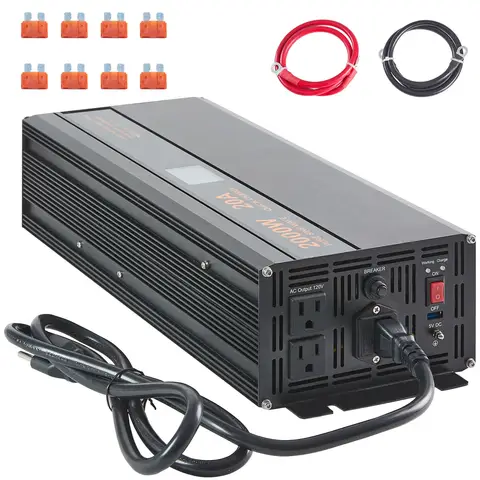
What Is a 2000 Watt Inverter and When Should You Use It?
Answer: A
2000 watt inverter is a power conversion device that transforms direct current (DC) from a battery into alternating current (AC), which is used by most household appliances. It is ideal for powering mid-sized electronics and tools, such as refrigerators, microwaves, and power tools.
- 2000 Watt Inverter
- A device that converts DC power from a battery into 120V or 240V AC power, suitable for running appliances and tools with a combined wattage of up to 2000 watts.
- Continuous Power
- The maximum amount of power an inverter can supply continuously without overheating or shutting down.
- Surge Power
- A short-term power boost that allows the inverter to handle the initial startup surge of certain appliances, such as refrigerators or compressors.
In a real-life scenario, imagine a weekend camping trip where you need to power a small refrigerator, a coffee maker, and a few LED lights. A 2000 watt inverter is the perfect solution for this setup. It provides enough power to run these devices simultaneously without overloading the system.
- Connect the inverter to a 12V battery with proper wiring and fuses.
- Plug your appliances into the inverter’s AC outlets.
- Monitor the inverter’s load to ensure it does not exceed 2000 watts continuously.
When choosing a 2000 watt inverter, look for one with a surge rating of at least 4000 watts to handle startup surges. Also, ensure it has built-in safety features like overload protection and low-voltage shutdown.
How to Choose the Best 2000 Watt Inverter for Your Needs?
Answer: The best 2000 watt inverter for you depends on your specific use case, such as camping, home backup, or job site power. Look for inverters with high surge ratings, pure sine wave output, and durable construction. When selecting a 2000 watt inverter, consider the following factors:
| Feature | Description |
| Surge Power | Should be at least 4000 watts to handle appliances with high startup loads. |
| Wave Type | Pure sine wave is recommended for sensitive electronics like laptops and TVs. |
| Efficiency | Look for inverters with 90% or higher efficiency to minimize battery drain. |
| Portability | Choose a lightweight model with built-in handles if you need to move it frequently. |
For example, a construction worker who needs to power a circular saw and a drill on a job site would benefit from a 2000 watt inverter with a 4000 watt surge rating and a rugged, dust-resistant design. On the other hand, a camper who wants to run a mini-fridge and a coffee maker would prefer a compact, lightweight inverter with a pure sine wave output.
- Identify the total wattage of the devices you plan to power.
- Check the inverter’s surge rating to ensure it can handle startup surges.
- Verify the inverter’s output type (pure sine wave vs. modified sine wave).
- Consider the battery compatibility and charging options.
If you're unsure about the exact wattage of your devices, refer to the manufacturer’s specifications or use a wattage calculator. This will help you avoid underpowering your inverter and ensure safe and efficient operation.
What Are the User Reviews Like for 2000 Watt Inverters?
Answer: User reviews for 2000 watt inverters are generally positive, especially for models with high surge ratings and pure sine wave output. Most users appreciate the reliability and performance of these inverters in both camping and home backup scenarios. Many users highlight the importance of surge power when running appliances like refrigerators and air compressors. One user shared their experience of using a 2000 watt inverter during a power outage to keep their refrigerator running. They noted that the inverter’s 4000 watt surge rating was crucial in handling the startup load of the fridge. Another user, a weekend camper, praised the inverter’s portability and quiet operation. They used it to power a mini-fridge, a coffee maker, and a few LED lights during a three-day camping trip. They emphasized the importance of a pure sine wave inverter for their laptop and phone charging. Common complaints include overheating in poorly ventilated spaces and the need for a high-quality battery to support continuous use. Some users also noted that the inverter’s efficiency can vary depending on the load and battery condition.
- Overheating
- A common issue with inverters when used in enclosed spaces or under heavy load for extended periods.
- Efficiency
- The percentage of input power that is converted to usable output power; higher efficiency means less battery drain.
To avoid overheating, ensure the inverter is placed in a well-ventilated area and not covered. Also, use a battery with sufficient capacity to support the inverter’s load. A 12V deep-cycle battery is recommended for continuous use.
Other Users Are Also Interested in These Inverters
If you're interested in a 2000 watt inverter, you might also want to explore other inverter options based on your power needs. For smaller devices, a 200 watt or 500 watt inverter may be sufficient. For larger appliances and tools, consider a 2500 watt, 5000 watt, or even an 8000 watt inverter. Some users have also asked about the differences between a 2000 watt and a 20000 watt inverter. While a 2000 watt inverter is suitable for mid-sized power needs, a 20000 watt inverter is designed for heavy-duty applications like powering an entire home during a blackout. For those who need a dual inverter setup, a 2000 watt 4000 watt inverter can provide additional power when connected to two batteries. This is particularly useful for extended off-grid use or when running multiple high-wattage appliances simultaneously. If you're looking for a compact and portable option, a 200 watt inverter is ideal for charging small devices like phones and tablets. For more power, a 1000 watt inverter can handle a wider range of appliances, including small refrigerators and microwaves. In summary, the right inverter depends on your specific needs and the devices you plan to power. Always check the wattage requirements of your appliances and choose an inverter with a sufficient continuous and surge rating.